What We Measure.
Why it works.
How it works.
The diagnostic reads your team as a system — not a collection of individuals. Eight interconnected dimensions. Four analytical lenses. One clear picture of what’s actually happening, and exactly where to act first.
People or leaders working with any team of 6 or more toward a shared goal — even where members work independently. If each person’s contribution shapes a common outcome, the diagnostic can read it as a system.
This is not a performance management tool — and it’s not designed to build a case against anyone. Every finding is systemic, never personal. The purpose is always the same: to create the conditions for your team to do its best work.
The full field of
team performance.
Our diagnostic maps your team across the full Performance Field — eight interconnected drivers that determine how teams create sustainable results. No driver operates in isolation; the pattern across the field is what reveals the root cause. Most assessments look at one or two areas in isolation. We read the whole system — because that’s where the answer lives.
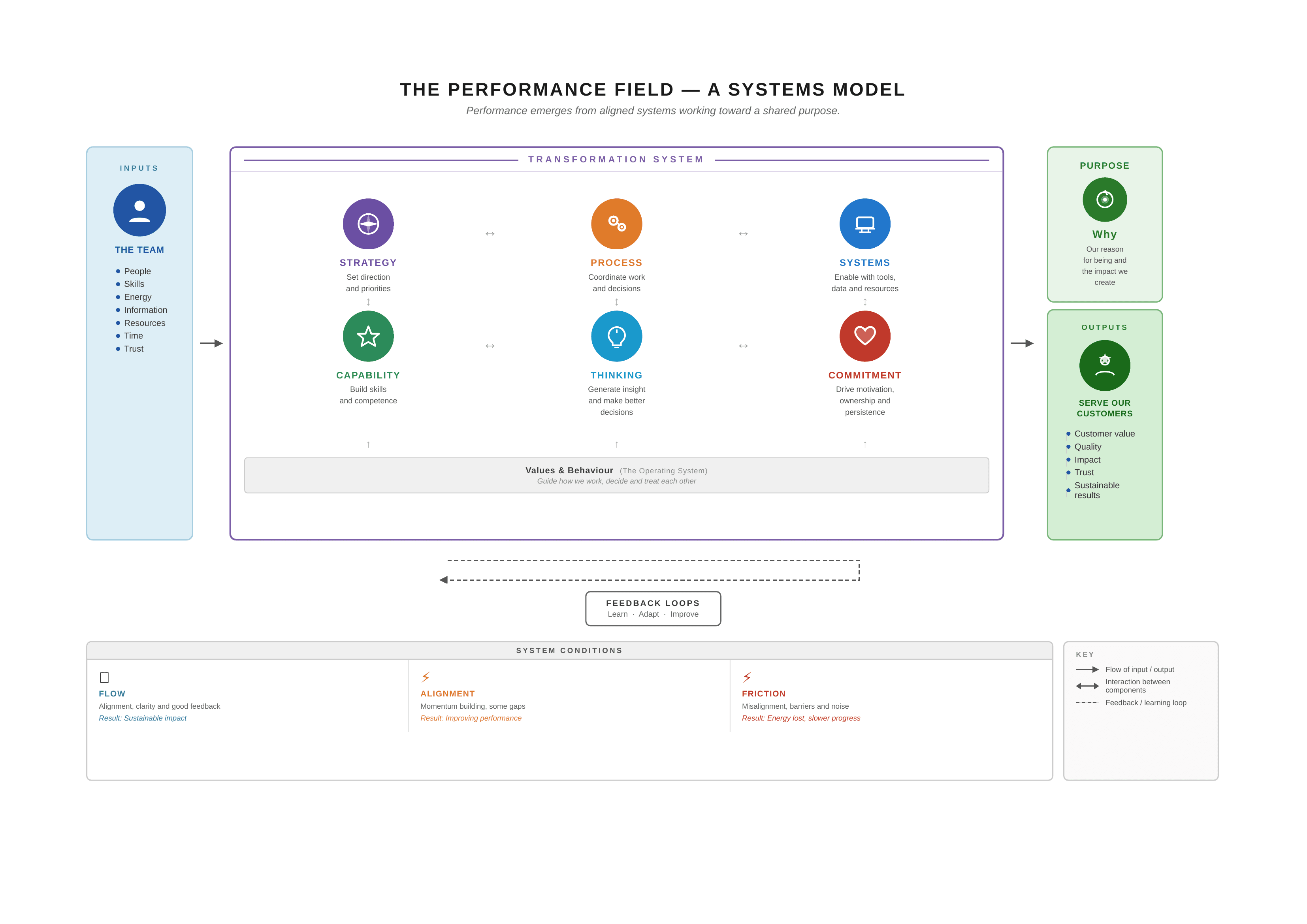
The Performance Field — a systems model. Performance emerges from aligned systems working toward a shared purpose.
Four lenses.
One clear picture.
Every team has patterns — in how it communicates, decides, holds itself to account, and responds to pressure. Most assessments describe those patterns in isolation. This diagnostic maps how they interact — because root causes almost never live where the symptoms appear.
What is currently enabling your team
The conditions, behaviours, and structures that are working right now. We measure what's functioning, not just what isn't — because knowing where your strengths concentrate is what makes resolving the friction both faster and safer.
Where drag concentrates — and what's creating it
Not the most visible symptom. The actual source. Mapped across eight interconnected elements and ranked by impact — so you address what's costing you most, not what's making the most noise.
Distribution across the team — not averaged scores
We measure the spread of individual scores, not just the mean. A team averaging 5 could mean everyone scores 5 — or scores split 2 and 8. These require completely different responses. Distribution scoring reveals the difference.
Leader perception vs. team experience — across all eight elements
We measure how the leader sees the team against how the team sees itself, element by element. This gap is the finding most assessments miss entirely — and the one that almost always explains what's actually happening.
Five things that make
the difference.
How it works.
This is not a survey you send and a report you receive. It’s a structured process — designed to surface what surveys miss and give you clarity that’s specific, actionable, and yours.
Understand the Context
1 – 2 hoursA focused session with the leader to understand their concerns, aspirations for the team and what may be getting in the way of performance. This also establishes whether The Performance Field Diagnostic is the right fit and, if so, confirms participation and logistics.
Prepare the Team
1 hour | VirtualThe team is introduced to the purpose, process and value of the diagnostic. Particular attention is given to building buy-in, creating psychological safety and providing clarity around confidentiality.
Complete the Diagnostic
20 minutes | VirtualThe team, leader and leader's manager each receive a private link to complete the diagnostic. Individual responses remain confidential.
Leader Feedback
2.5 hours | In personThe leader receives the findings first, providing space to understand how the team is experiencing the current environment and to reflect on the results openly and constructively. Where appropriate, potential ways forward are explored.
Team Feedback
2.5 hours | In personThe findings are explored with the team in a way that encourages curiosity rather than blame or defensiveness. The focus is on understanding what sits beneath the issues, identifying root causes and building shared ownership for sustainable improvement.
Agree the Way Forward
Tailored to the teamThere is no standard prescription. The team may feel equipped to take the findings forward independently or may choose additional support. This can range from individual or tripartite coaching to team coaching, targeted workshops or facilitated solution sessions. The way forward is determined by what the team and leader need.
Before anyone answers a single question,
we’ve already done the work.
The diagnostic works because of what we put in place before it runs. The conditions aren’t accidental — they’re engineered. That’s what makes the conversation honest, and the findings usable.
We set the conditions with the team first.
Before the diagnostic runs, we run a team session — we explain the why, answer their questions, and establish what this is together. The team walks in knowing what they're part of and why it matters for them.
The data names the system. Not the people.
What surfaces is aggregated — patterns in how the team operates, not who said what. You see where the system is aligned or misaligned. That's what makes it actionable. And it's what makes people honest enough to give you real data.
The debrief is designed for clarity.
Leaders are often surprised by parts of the feedback. Some findings confirm what they already sensed; others surface patterns, gaps or perceptions they had not seen. The value lies in making the team's experience visible, understandable and actionable.
If it's not the right fit, we'll tell you.
The first conversation is a real one. If the diagnostic isn't right for where you are, we say so — before you commit to anything. We'd rather point you somewhere better than take a brief we can't move the needle on.
The cage works because of the engineering. We spend as much time on the conditions as we do on the findings.
Built on research.
Proven in practice.
The eight elements we measure are grounded in decades of validated organisational research — not a proprietary black box.
Ready to see what’s actually happening
in your team?
One conversation. We’ll tell you honestly whether this is the right fit for where you are right now.
Book a ConversationNo pitch. No obligation. Investment discussed in the call.